Local SEO for service businesses: a plain-English guide
You do not need to learn marketing jargon to show up on Google. Here is what local SEO is, what it actually does, and the small set of things every service business should do first.
6 min read
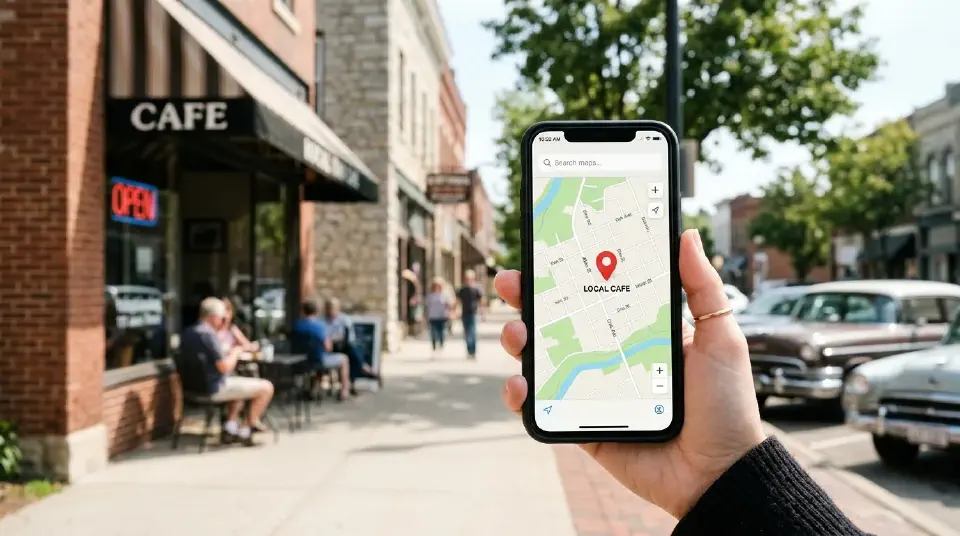
Search engines have a million words for what they do. The one that matters for a service business is local. Local SEO is the practice of helping Google show your business when somebody nearby is looking for what you do.
You do not need to be a marketer to get this right. You do need to know what to focus on, because most “SEO advice” online is written for online businesses competing against the entire internet. That is the wrong frame for a roofer in Dover.
This is the short version. Everything below is something a small service-business owner can do or check today, no agency required.
What “local SEO” actually means
When someone in your service area searches for plumber or carpet cleaning near me, Google has to pick which businesses to show. It mostly looks at three things:
- Relevance. Does the business actually do this work?
- Distance. Is it close enough to be worth showing?
- Prominence. How much does Google trust this business based on the rest of the web?
Your job in local SEO is to give Google clear, consistent answers to all three.
The single most important thing: Google Business Profile
If you do nothing else, set up and complete a free Google Business Profile. This is the listing that appears in the map pack, in Google Maps, and on the right side of search results when someone looks up your business name. It is the bedrock of being found locally, and it is free.
Once you set it up:
- Pick the most specific category that fits. House cleaning service is better than cleaning service.
- Add your real service area. List the towns and zip codes you serve.
- Add at least 10 photos of actual work. Real photos. Not stock.
- List your real hours. Update them when they change.
- Add the services you offer with short, plain descriptions.
When customers leave reviews, reply to them. Quickly, briefly, in plain language. Google rewards businesses with active, recent activity on their profile.
A complete and active Google Business Profile is, on its own, more valuable than most paid SEO work for a small service business.
A real website, on a real domain
Your Google Business Profile is on Google’s land. You should also own a small piece of the web yourself, on a real domain like smithpaintingdover.com. This matters for two reasons.
First, search engines look at your website to understand what your business does. Your domain name, the words on your homepage, and the basic structure of the site all feed Google’s understanding of your relevance.
Second, when somebody searches your business name directly, having your own domain at the top of the results signals legitimacy. A search that returns only social profiles looks like a small business; a search that returns a real website at a real domain looks like a real business.
The site does not have to be elaborate. It does have to exist, work on a phone, and answer the basic questions about what you do and where.
Naming things the way customers do
Here is a place where small business websites quietly lose ground. Owners describe their work the way professionals talk about it. Customers search the way regular people talk.
If your customer searches for gutter cleaning, your website should say gutter cleaning. Not exterior maintenance services. Not full-service home protection. The first one matches how Google indexes the search; the others do not.
The same goes for service area. Customers search plumber Newark Delaware, not plumbing solutions in the greater Delaware metro corridor. Use the place names your customers use.
This sounds obvious. It is also the single most common mistake on service-business websites.
NAP consistency: the boring thing that matters
NAP stands for Name, Address, Phone. The unsexy rule of local SEO is that your business name, address, and phone number should be identical everywhere they appear online.
That means your Google Business Profile, your website, your Facebook page, your Yelp listing, the chamber of commerce directory, the old listing your cousin made you in 2018: all of them should have the same spelling of your business name, the same address format, and the same phone number.
When Google sees the same NAP on twenty different sites, it builds confidence that the business is real and well-established. When Google sees three different phone numbers and two different spellings of your name, it does not know who to trust.
Reviews, the unfair advantage
Reviews are the most lopsided part of local SEO. A small service business with thirty real, recent, four- and five-star reviews will routinely outrank a much larger competitor with stale or sparse reviews. The math actually works in your favor here, because you only need a few dozen happy customers to start, and you almost certainly have those already.
Two rules:
- Ask everyone, every time. Most happy customers will not think to leave a review unless asked. The sentence is “If you have a minute, a Google review really helps us.” Send it as a text after the job. Send it as a printed card. Either is fine.
- Reply to every review, including bad ones. Especially bad ones. Calmly, briefly, professionally. Future customers read those replies more carefully than they read the reviews themselves.
What you do not need to worry about
A few things that pop up in SEO articles do not matter much for a small service business in your service area:
- Keyword density. Just write naturally about what you do.
- Backlink building schemes. A few real links from local places like the chamber of commerce or a partner contractor are worth more than a thousand garbage links from random blogs.
- Meta keywords. Google has publicly stated for years that it does not use the meta keywords tag for ranking. Skip it.
- Submitting to a hundred web directories. Most of those are spam. Pick five real ones and stop.
The frame: do the boring real-world stuff well. Skip the manufactured stuff.
A 30-day starter list
If you are doing this from scratch, here is a four-week order that gets the most important things in place first.
- Week 1. Claim your Google Business Profile. Add the right category, photos, and hours.
- Week 2. Audit your existing online listings. Make sure NAP is consistent on at least five places (your website, Google, Facebook, Yelp, your chamber).
- Week 3. Get your real website live on your own domain. Even a single page is fine to start.
- Week 4. Ask your last 20 happy customers for a Google review. Reply to every one that comes in.
That is the entire program. It is not glamorous and there is no software to buy. It is what works.
The long game
Local SEO is not a one-time project. It is a slow accumulation of doing the right small things over months. The businesses that win at local search are not the ones with the cleverest tactics. They are the ones who showed up, looked legitimate, and kept asking customers for reviews while their competitors did not.
The good news is that almost no one does the boring version. If you do, you will quietly out-rank most of your local competition within a year, and stay there.