Why your local service business needs a website in 2026
Most of your future customers will search for you on a phone before they ever pick up a phone. A simple, well-built website turns those searches into booked work.
6 min read
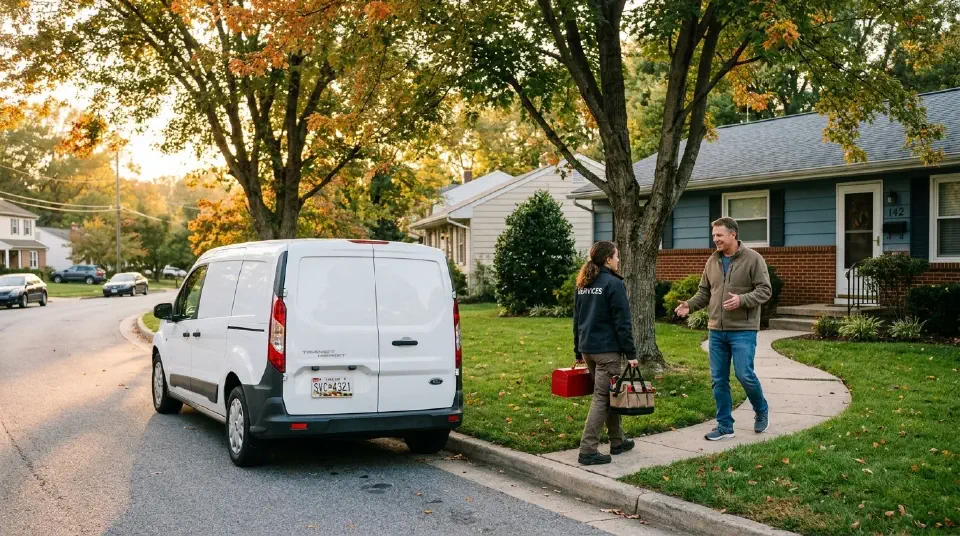
If you run a local service business, the way you get new customers has quietly changed. Word-of-mouth still matters. Yard signs still matter. But the first thing a prospective customer does when they hear your name is the same thing they do for a restaurant, a doctor, or a babysitter: they pull out their phone and search.
What they find when they search is what decides whether you get the call.
This post is about why a website matters for a small service business in 2026, what a “good” one actually needs to do, and why it matters even if every customer you have today came from a referral.
Searching is the new asking around
Think about how you find a new mechanic, a contractor for a kitchen remodel, or a vet that takes weekend appointments. Even if a friend recommended someone, you probably searched the name to confirm the business is real, see the hours, read a few reviews, and look at photos of past work. If nothing came up, or what came up was confusing, you almost certainly looked somewhere else.
Your customers do the same thing. The Pew Research Center reports that the majority of U.S. adults look up local information online before visiting or contacting a business. Google’s own data on search behavior consistently shows that “near me” searches and direct business-name searches are the two most common ways people find local providers.
The point is simple. The first impression of your business is no longer your truck or your sign or your friendly voice. It is the search result. If a search for your business name returns nothing, or returns a half-finished social profile, you are losing work to whoever does show up.
What a small service-business website actually has to do
A lot of small business owners have heard “you need a website” so many times it has lost meaning. Most agencies pitch a 20-page production with stock photos and an office address that is really a P.O. box. That is not what your customer wants.
A useful website for a service business does five things:
- Confirms the business is real. A name, a phone number, a service area, and a photo or two of actual work.
- Tells the customer exactly what you do. “We clean carpets” beats “premium soft-surface restoration solutions” every time.
- Gives them one obvious next step. A phone number to tap, a text-to-book button, a quote-request form. One.
- Shows up when somebody Googles your business name. Without that, the rest does not matter.
- Loads fast on a phone in a parking lot. Most of your traffic will be mobile, often on a slow connection.
Notice what is not on this list. You do not need a blog. You do not need a portfolio of fifty projects. You do not need a chatbot. You do not need pricing tiers. You probably do not even need a contact form longer than three fields.
Those are decisions you make later, if and when you need them. The website needs to be useful first.
“But all my customers come from referrals”
This is the most common objection, and it is mostly right. Referrals are the lifeblood of service businesses. A website does not replace them.
But here is what referrals miss. When somebody recommends you to a friend, that friend is going to do the same search anyone would. The referral got you considered. The website gets you confirmed.
If a referral leads someone to search your name and find nothing, the referral becomes a question. “Are they still in business? My friend used them years ago, are they even doing this anymore?” That doubt is enough for a busy person to look at the next plumber on the list.
A website that simply answers “yes, we are real, here is what we do, here is how to reach us” turns referral-into-doubt into referral-into-booking. That is the cheapest customer you will ever get, and you are losing some of them by not being there to greet them.
The cost of being invisible
Here is the test you can run today. Pick three searches a customer might do.
- Your business name
- Your service plus your town, like carpet cleaning Smyrna
- [your service] near me from inside your service area
Look at what comes up in the first screen. If your business does not appear, that traffic is going to a competitor. If a wrong business with a similar name appears, that traffic is going to a competitor. If a years-old social profile of yours shows up with a phone number you no longer use, those calls are going nowhere.
Every one of those is a missed customer. Not a thousand a year, but probably a few a month. For a service business doing five hundred dollar jobs, a few customers a month adds up.
What good looks like
A small service business website in 2026 should be:
- One to four pages, depending on the business. Most businesses can fit everything on a strong homepage with a simple contact section.
- Mobile-first. Designed for the phone screen, not shrunk down from a desktop layout.
- Fast. Under two seconds on a normal cell signal.
- Honest. Real photos, real names, a real phone number. Not stock images of stock people.
- Findable. Indexed by Google with the basic information a search engine looks for: business name, address, phone, service area.
It does not need to be fancy. It needs to be true and easy to use.
The hidden second job a good website does
Beyond getting found, a website slowly becomes the answer to the same questions you keep getting asked. Do you do same-day service? Do you take card? Do you serve Smyrna? What hours are you open? Every one of those questions is a phone call you do not have to answer if your site already does.
A site that quietly answers the boring questions frees up your day to do the work. That is the real value, and it shows up not in week one but in month six.
What to do next
If you have nothing right now, start with the basics. A single page with your name, what you do, where you do it, and a way to reach you. Hosted on a real domain, not on someone else’s profile page. Indexed by Google so a search for your business name finds it.
That single page will outperform almost any social profile you currently have, and it will keep working in the background while you do the actual work.
If a 20-page production has been the thing holding you back, throw the idea out. Build the smallest useful version, get it live, and let it grow as you find out which questions your customers actually ask.
The goal is not to win design awards. The goal is to be the easiest service for your next customer to choose.