Lawn care website essentials: what homeowners actually want to see
A short, practical list of what to put on a lawn care website so a busy homeowner books you instead of bouncing to the next result.
7 min read
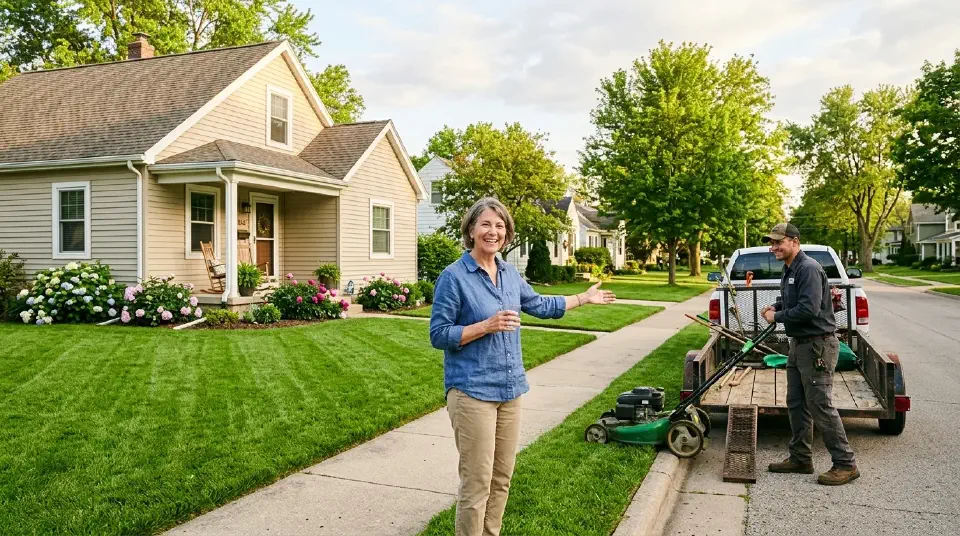
If you cut grass, weed beds, or run a small landscaping crew, your customers fall into a few predictable patterns. They are busy. They are price-conscious but not cheap. They want to know two things in under twenty seconds: can you do my yard, and how do I get on your schedule.
A lawn care website that answers those two questions clearly will out-book a prettier site that buries the answer. This post is a checklist of what to put on yours, in the order it actually matters.
Start with the answer to one question: who is this for?
A homeowner landing on your site needs to confirm, almost instantly, that you serve their kind of property. Three seconds of doubt is enough to bounce.
Your homepage hero should answer this in one sentence. Not “premium turf solutions for the Mid-Atlantic.” Try one of these:
- “Weekly lawn mowing for homes in Kent County, Delaware.”
- “Affordable lawn care for the Dover area, since 2018.”
- “Local lawn mowing and bed maintenance, serving Smyrna, Camden, and Dover.”
Names of towns matter. The homeowner is checking that you cover their address. Specific town names do that job better than abstract phrases like “the local area.”
The phone number, on every page, tappable
A surprising number of lawn care websites bury the phone number in a contact page that takes two taps to reach. Do not do this.
Put a real phone number in the header of every page. On mobile, it should be a tel: link so a tap calls. Do not use an image of a phone number; do not put it inside a graphic; do not write it as “five-five-five” because you are worried about scrapers. Make it tappable, real, and visible above the fold.
If you also want a text option, fine. Put it next to the phone number with a clear label.
A simple service list, in homeowner words
Keep this short. The reader is mentally mapping their yard to your services.
A useful structure is three to seven services with one-sentence descriptions:
- Weekly lawn mowing. Cut, edge, blow off the walks. Most yards take 30 to 60 minutes.
- Bed maintenance. Weed pulling, mulch refresh, edge cleanup.
- Spring and fall cleanups. One-time leaf removal and seasonal reset.
- Hedge and shrub trimming. Clean lines on overgrown shrubs.
Notice what is missing: jargon, season-specific terminology homeowners do not use, and acronyms. Aeration is fine because homeowners search for it; core cultivation is not.
If you have specialties, add them. Just keep the list scannable.
Service area, by town
This is the single biggest local-SEO win a lawn care site can do, and most do it badly or not at all.
Have a section that lists the towns and zip codes you serve, by name. Not “the greater area.” Not a vague paragraph. A clear list:
We serve homes in Dover, Smyrna, Camden, Wyoming, Cheswold, Magnolia, Felton, and Little Creek. If you are within 10 miles of Dover, give us a call.
Two reasons. First, when a homeowner in Camden searches lawn care Camden Delaware, your site has a much better chance of ranking when “Camden” appears as a real word in the page. Second, the homeowner reading the site sees their town in the list and feels confident enough to call. That confidence is doing real conversion work.
Pricing: enough to set expectations, not enough to commit
You do not need to publish exact prices. You also should not publish nothing. Most homeowners abandon a site that hides pricing entirely, because they assume you are expensive and they do not want to ask.
The right level of disclosure is a starting price or a range, with the honest caveat:
Most weekly mowing on a quarter-acre lot starts at $45 per visit. Pricing depends on yard size, slope, and access. For an exact quote, send us a photo of your yard and we will text you back the same day.
That gives them a reference point, sets a floor, and gives them a low-friction next step (text a photo) that is easier than calling.
Real photos, not stock
This matters more than people think. A lawn care site with three real before-and-after photos of yards in the area will out-convert a site with twenty pristine stock images. The reason is simple: a homeowner looking at stock photos can tell. They subtract trust accordingly.
Take pictures with your phone after every job you are proud of. Label them with the town: Smyrna front yard cleanup, Wyoming bed reset. Even ten of these is plenty for a small site.
Schedule and availability
Two sentences solve this:
We mow Monday through Saturday during the season, generally 7am to 6pm. Most new customers can be added to the schedule within a week.
The second sentence is doing real work. The homeowner is comparing you mentally to other businesses, some of whom are quoting “we are booking for July” in April. If you can be there next week, say so. If you are booked out, say that honestly too. Busy is a buying signal.
Contact, with a single primary path
Pick one way to be contacted and put it front and center. The other ways are secondary.
- Best for lawn care: text-with-a-photo. Most homeowners find it easier than describing their yard out loud, and you get a workable estimate from a yard photo plus an address. A “Text us a photo of your yard” CTA does well.
- Second-best: phone, especially for older customers.
- Third: a short form. Three fields max: name, address, what you need. Long forms hurt conversion.
Avoid “contact us” pages with a generic email and no preference. People will pick the easiest option, and if you do not steer them, the easiest option might be “leave the site.”
Reviews and social proof, kept honest
If you have Google reviews, link to your Google Business Profile. If you have testimonials from real customers, quote them with the customer’s first name and town. If you have neither yet, do not invent some. Empty social-proof sections look worse than a missing one.
“They got our yard back into shape after the previous service ghosted us. Quick, polite, fair price.” Lisa, Smyrna
That is more persuasive than “Five-star service since 2015” without anything to back it up.
What you do not need
A few things lawn care websites often add that do not move the needle:
- A blog. Useful eventually, but not on day one. Most homeowners are not reading lawn care articles before they pick a vendor.
- A “team” page with bios. Fine, but not necessary. A single line (“Family-owned, in business since 2018”) does the same job.
- An online quote calculator. Sounds clever, never quite gets the answer right, and frustrates customers.
- A chatbot. Honestly, just text them back yourself. The personal touch is part of why someone hires a small lawn business.
The minimum useful site is one good page. Add things only when a real customer-conversation makes you wish the site already had them.
A small SEO thing that actually moves bookings
Here is one more lever specific to lawn care. Search trends for lawn services are deeply seasonal: most homeowners look for a service in March and April, then again before holidays in summer, then in late fall for cleanups. Update your homepage with seasonal language a few weeks before each peak.
In late February: now booking for spring mowing season. In May: adding new weekly customers, openings on most routes. In October: fall cleanups available, leaf removal weekly through November.
Google rewards freshness. Customers click results that mention the season they are searching in. Two minutes of editing per quarter can lift bookings noticeably.
What this is really about
A lawn care website’s job is not to impress a designer. It is to take a homeowner who is standing in their kitchen looking at a too-long lawn and turn them into a confirmed appointment.
If a busy homeowner can land on your homepage, find their town in the service area, see a starting price, tap to text you a photo of their yard, and get a reply by lunchtime, you have done your job. Everything else is decoration.
Most of your competitors will never get this right. Doing the basics well is, on its own, a real competitive advantage.